A certain colour-prediction app keeps turning up in WhatsApp forwards, Telegram groups and short videos, usually presented as a quick, colourful way to pass the time. If your idea of mobile gaming is a round of Ludo King with cousins or a few Candy Crush levels on the metro, it is worth knowing why apps like this sit in a very different category, and what to check before you install anything.
Table of Contents
1. A Real-Money Product, Not a Casual Game
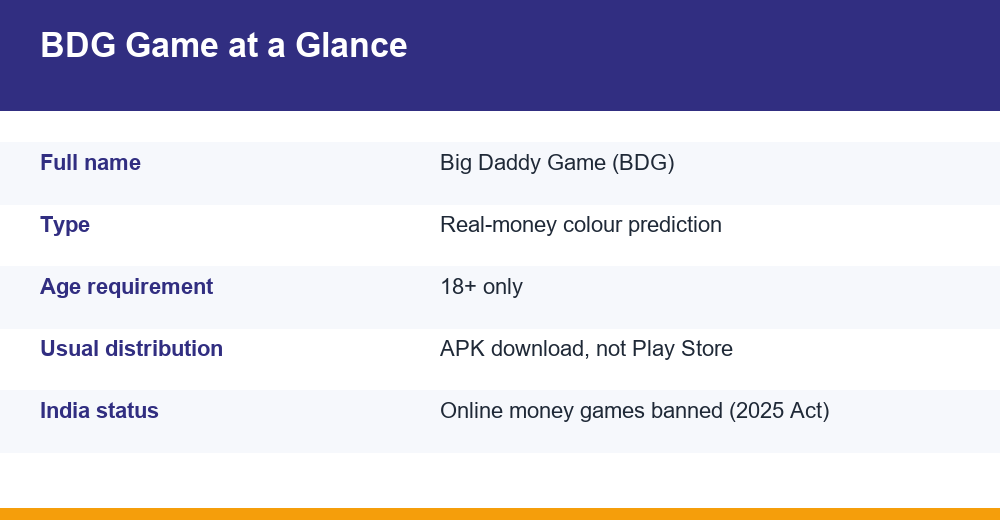
Casual games like Ludo King, Candy Crush or Subway Surfers make money from adverts and optional in-app purchases. You can lose a match, but you never lose your wallet balance because a dice roll went the wrong way. Big Daddy Game works on a completely different model: you add rupees, you stake them on outcomes, and you either get a payout or lose the stake.
That is the single most important thing to understand. The bright colours, countdown timers and cartoon-style buttons look like a casual game, but the core loop is wagering real money.
We have covered this design overlap before when comparing a casino slot app with a casual slot game. The visuals can be almost identical; what matters is whether real money goes in and comes out.
2. How Colour Prediction Works and Why the House Wins
Colour prediction is simple on the surface. A round runs for a short, fixed period, often a minute or a few minutes. You pick a colour (commonly red, green or violet), a number or a size option, place a stake, and wait. A correct pick returns a multiple of your stake; a wrong pick loses it.
The result is generated by the platform, and you have no way to inspect how. Claims of “prediction tricks” or paid “signal” groups should be ignored: past rounds do not tell you what comes next, and anyone selling certainty is selling something that cannot exist.
The built-in house edge
Games of this kind are designed so that payouts are slightly smaller than the true odds justify. That gap is the house edge, and it means the expected value of each bet is negative for the player. You may win some rounds, but over many rounds the maths favours the operator.
As a purely illustrative example, suppose a colour pays 2x your stake but comes up 45 times in 100. Betting ₹100 a round, you would on average get back ₹90, an average loss of ₹10 per round. Short rounds mean many bets per hour, so that adds up fast.
3. Sideloaded APKs vs the Play Store
Casual gamers almost always install from Google Play or the App Store, which scan apps, enforce content policies and offer refunds through a known process. Colour-prediction platforms are generally not listed there. Instead they are installed as an APK file downloaded from a website or a link shared in chat groups.
Sideloading means switching on “Install unknown apps” and installing a package no store has reviewed. That does not automatically make a file harmful, but it removes a layer of protection. You cannot easily confirm who built it or whether the version from a forwarded link has been modified. At minimum, keep Google Play Protect on and never install a file from a random Telegram or WhatsApp link.
The operator publishes its own account of the BDG Game app and what it offers. It is worth reading for exactly what it is, which is a company describing its own product rather than anyone assessing it.
4. Permissions, Personal Data and KYC
A puzzle game needs very little from your phone. A real-money app handles payments, so it will usually ask for your mobile number and may request identity or bank details for withdrawals. Our guide to casino app permissions for casual gamers explains which requests are normal and which deserve a second look.
| Permission | Reasonable? | Why it matters |
|---|---|---|
| Read SMS | Be cautious | Could expose bank OTPs |
| Contacts | Rarely justified | Can be used for referral spam or worse |
| Accessibility service | Red flag | Can read screens and act on your behalf |
5. Strictly 18+, and Why Younger Players Get Pulled In
Real-money gaming is for adults only. Any platform that takes deposits and pays out cash is unsuitable for anyone under 18, full stop. This matters because many Ludo and Candy Crush players are school and college students, and the promotion of colour-prediction apps often reaches them first.
The pitch usually arrives through referral links, influencer clips and group chats promising “easy pocket money”. Tiny minimum stakes make it look harmless, yet a teenager can lose savings or a parent’s UPI balance surprisingly quickly. Parents can use Google Family Link or similar controls to block unknown app installs, and keep an eye on statements for small, repeated payments to unfamiliar merchants.
7. Spending Risk and Chasing Losses
The biggest everyday risk is not a dramatic single loss but steady leakage. Fast rounds, small stakes and instant UPI top-ups make it easy to spend far more than you planned, and casual gamers used to free play are rarely in the habit of tracking spend. A simple habit helps: note every top-up and review the weekly total honestly.
Watch for chasing losses: raising stakes to win back what is gone. Because each round has negative expected value, chasing usually deepens the hole. Bonus offers can also lock funds behind wagering conditions, so balances that look large may not be withdrawable. Users also report delayed withdrawals and support that exists only in chat apps.
8. Red Flags and Where to Get Help
We have no evidence to call this particular app a scam, and this article does not do so. But the wider colour-prediction space has attracted fraudulent clones and fake agents, so it helps to know the warning signs.
| Red flag | Safe check |
|---|---|
| Promises of guaranteed daily earnings | Remember outcomes are chance with a house edge |
| Paid “prediction” or VIP signal groups | Ignore them; results cannot be predicted |
| Pressure to deposit more to unlock a withdrawal | Stop and do not send further money |
If anyone has asked you to install a betting app as part of a job, task or investment offer, treat it as a likely fraud attempt. Report online financial fraud quickly through the national cybercrime portal, cybercrime.gov.in, or by calling the helpline 1930; speed matters for freezing transfers.
If gaming or money worries are affecting your sleep, studies, work or relationships, free and confidential support is available from Tele-MANAS, the government’s mental-health helpline, on 14416 or 1-800-891-4416, in multiple Indian languages, around the clock.
For casual gamers, the simplest rule is this: if a game needs your money before it lets you play, it is not a casual game. Stick to titles from official stores, keep your UPI PIN and OTPs private, and enjoy gaming that only costs you time.
Frequently Asked Questions
Is a colour-prediction app the same as casual games like Ludo King?
No. Ludo King and Candy Crush are free or ad-supported, and you never stake real money on outcomes. Colour-prediction apps ask you to deposit rupees and bet on colour or number results. That makes them real-money products with a built-in house edge, suitable only for adults.
Can colour prediction results be predicted with tricks?
No. Results are generated by the platform and cannot be reliably predicted from past rounds. Paid signal groups sell certainty that does not exist, and because payouts include a house edge, the expected value of every bet is negative for the player over time.
What should I do if I lost money to a fake colour prediction agent?
Act fast. Report the fraud at cybercrime.gov.in or call the national cybercrime helpline 1930, keeping screenshots of chats and payment references. Inform your bank too. If the stress is affecting you, Tele-MANAS on 14416 offers free, confidential mental-health support.